


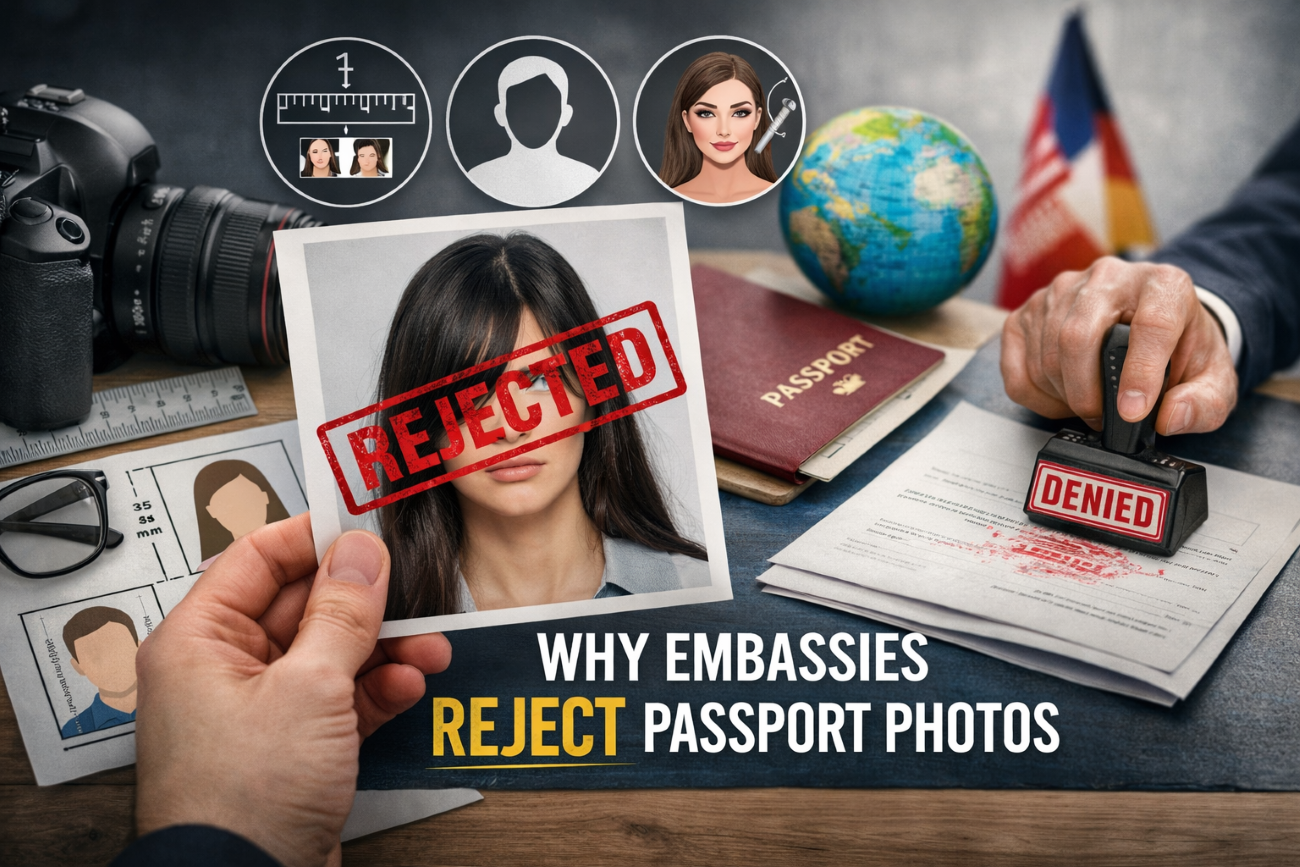
Passport photographs play a critical role in visa and passport applications. They are not just identification images, they are biometric tools used by embassies to verify identity, prevent fraud, and support border security systems. Because of this, embassies enforce very strict photo standards. Even minor mistakes can result in rejection, delays, or a request for resubmission.
Here, we will explore a detailed explanation of why embassies often reject passport photos and what applicants should understand before submitting theirs.
1. Strict International and Embassy-Specific Regulations
Most embassies follow international biometric standards set by organizations such as the International Civil Aviation Organization (ICAO). In addition to these global rules, individual countries may introduce their own extra requirements.
This means a photo accepted by one embassy may be rejected by another. Differences may include size, head position, facial proportions, or background shade. Applicants who reuse old photos from previous visas often face rejection for this reason.
2. Incorrect Photo Size and Facial Proportions
Embassies do not only check the physical size of the photo, they also check how much of the image the face occupies. The head must fall within a specific percentage of the photo frame.
Photos that are zoomed in too much, cut off at the chin or forehead, or too far away from the camera are considered invalid. Even when the photo dimensions appear correct, improper scaling can still lead to rejection.
3. Background Errors and Shadow Problems
A clean, uniform background is essential for accurate facial recognition. Most embassies require a white or light-colored background without patterns or textures.
Shadows behind the head, on the face, or around the shoulders can interfere with biometric scanning. These shadows often occur when lighting is placed incorrectly or when photos are taken too close to a wall.
4. Lighting and Color Accuracy Issues
Lighting must be evenly distributed across the face. Overexposed photos that appear too bright, or underexposed photos that appear dark, are commonly rejected.
Incorrect color balance can also be an issue. Photos that look yellow, bluish, or grey due to poor camera settings do not accurately represent skin tone. Embassies require natural color reproduction to ensure consistent identification.
5. Facial Expression and Eye Visibility Requirements
A neutral facial expression is mandatory because facial recognition systems analyze muscle positioning and facial geometry. Smiling, raised eyebrows, or squinting changes facial structure and affects biometric accuracy.
Eyes must be fully open and clearly visible. Red-eye effects, reflections, or shadows over the eyes can result in rejection. Applicants should look straight at the camera, not above or below it.
6. Head Position, Posture, and Alignment
Embassies require the head to be centered, upright, and facing directly forward. Tilting the head or angling the shoulders can distort facial symmetry.
The shoulders should be visible and level, with the face positioned squarely within the frame. Photos taken casually, such as selfies, often fail this requirement.
7. Glasses, Contact Lenses, and Eye Obstructions
Many embassies now prohibit glasses entirely, including prescription glasses. Reflections, glare, frame shadows, or tinted lenses make it difficult to clearly capture the eyes.
Colored or patterned contact lenses are also not permitted, as they alter the natural appearance of the eyes. Only transparent corrective lenses may be allowed, depending on embassy rules.
8. Clothing, Uniforms, and Accessories
Clothing should be simple and contrast with the background. White or very light clothing against a white background can cause the applicant’s outline to blend into the background.
Uniforms, camouflage clothing, or clothing resembling official attire may be rejected. Accessories such as hats, headbands, scarves, large earrings, or fashion items are generally not allowed, as they distract from facial features.
9. Religious and Medical Head Coverings
Religious head coverings are allowed, but strict conditions apply. The face must be fully visible from the bottom of the chin to the top of the forehead and from ear to ear.
Medical head coverings may also be permitted with supporting documentation. However, shadows or folds that obscure facial features can still lead to rejection.
10. Image Quality, Resolution, and Printing Issues
Photos must be sharp and high resolution. Grainy images, pixelation, or printing defects are unacceptable. Printed photos should not have creases, ink marks, or smudges.
Low-quality printers or glossy finishes that reflect light may also cause embassies to reject the photo.
11. Use of Filters, Editing, and Retouching
Embassies strictly prohibit digital editing. This includes skin smoothing, blemish removal, background replacement, and facial reshaping.
Even minor enhancements made automatically by smartphone cameras can disqualify a photo. Embassies require natural, unaltered images to maintain biometric integrity.
12. Outdated Photos and Appearance Changes
Most embassies require photos taken within the last six months. Older photos may not reflect current facial features, especially after changes such as weight fluctuation, facial hair growth, hairstyle changes, or cosmetic procedures.
Applicants sometimes reuse older passport photos, not realizing this is a common reason for rejection.
Conclusion
Embassy passport photo requirements are precise for a reason. They support global security systems, reduce identity fraud, and ensure smooth border processing. A rejected photo may seem minor, but it can delay visa processing, increase costs, and disrupt travel plans.
To avoid rejection, applicants should always review the specific embassy’s photo guidelines and use professional photo services familiar with visa and passport standards. Attention to these details increases the chances of a smooth and successful application process.
Fill this FORM to get visa support today.

Other Articles
How to Avoid Accommodation Scams Abroad
When You Should NOT Book a Flight, Even if It’s Cheap
No Comment! Be the first one.