


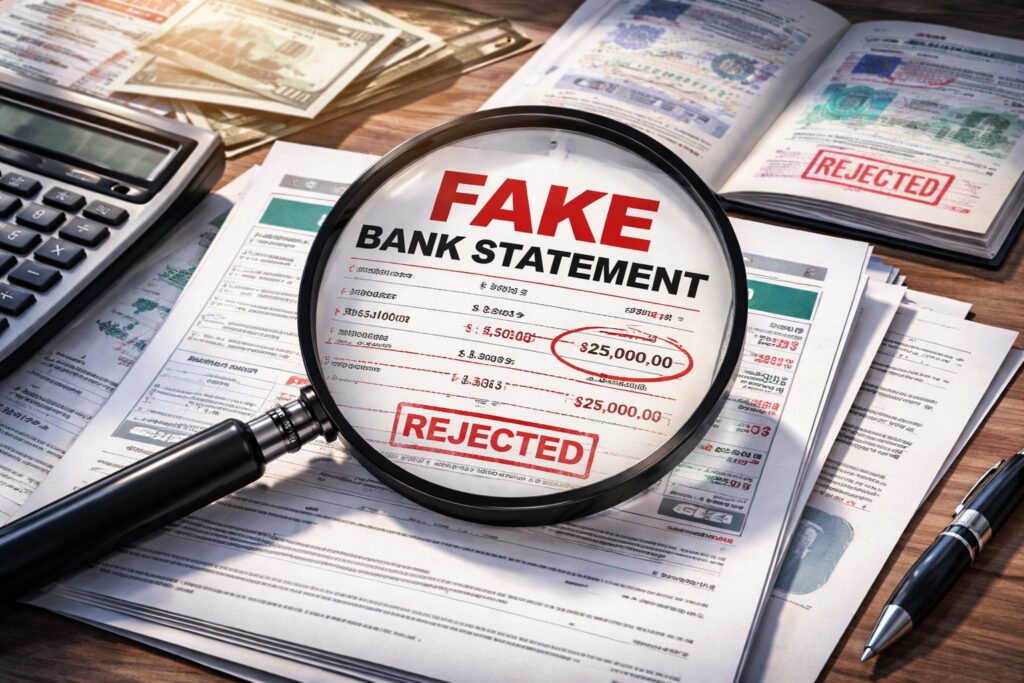
In today’s world of international travel, financial documentation plays a critical role in visa approvals, study permits, business trips, and even residency applications. Among these documents, the bank statement is one of the most scrutinized. Yet, despite repeated warnings from embassies and immigration authorities, some applicants still attempt to submit fake or altered bank statements. It may seem like a shortcut. It is not. In reality, falsified financial records are detected more often than people realize, and the consequences can be severe and long lasting.
This article explains why fake bank statements always get caught, how verification systems work, and why honesty is not only ethical but also strategic when applying for any travel related process.
The Growing Sophistication of Verification Systems
Many applicants assume that visa officers only glance at submitted documents. That assumption is dangerously outdated. Modern immigration systems are highly digitized and interconnected. Embassies do not rely solely on printed documents. They use verification technologies, fraud detection software, and internal databases to confirm financial authenticity.
Financial documents are examined for consistency in formatting, transaction patterns, account history, and banking codes. Even subtle discrepancies in fonts, spacing, logos, or transaction references can raise immediate red flags. Banks use standardized formatting systems, and immigration officers are trained to recognize deviations from genuine templates.
In addition, many embassies now require bank statements to be directly stamped, signed, or transmitted from recognized financial institutions. Some go further by requesting verification letters or conducting direct confirmation checks with the issuing bank.
In short, the systems are smarter than most people think.
Direct Bank Verification Is Common
A common myth is that embassies do not have time to verify bank statements directly. That is incorrect. In high risk regions or where fraud patterns are common, direct verification is routine.
Immigration authorities may contact banks through official channels to confirm:
- Account ownership
- Date of account opening
- Average balance over a period
- Recent large deposits
- Authenticity of the document reference number
Banks take these inquiries seriously. Providing false information to a foreign government is a criminal offense in most jurisdictions. Financial institutions cooperate when formal verification requests are made.
Even where direct contact is not initiated, certain visa categories require applicants to submit bank verification codes or consent forms that allow authorities to confirm financial data electronically.
Transaction Patterns Reveal the Truth
One of the easiest ways fake bank statements get caught is through unrealistic transaction patterns.
A sudden large deposit made shortly before printing a statement raises suspicion. Visa officers review the history, not just the final balance. They assess whether funds are consistent with the applicant’s income level, employment type, and lifestyle.
For example:
- A student claiming modest family income but showing a very high sudden balance
- A salary earner whose monthly income does not align with declared employment
- A business owner whose account activity does not reflect business operations
These inconsistencies prompt further investigation. Financial credibility is not just about the number shown. It is about financial behavior over time.
Digital Forensics Detect Alterations
Technology makes it easier to edit documents. It also makes it easier to detect manipulation.
Most fake bank statements are created by:
- Editing PDF documents
- Using graphic design software to alter balances
- Changing transaction descriptions
- Modifying dates
However, digital documents carry metadata. Metadata includes hidden information such as file creation date, modification history, software used, and time stamps. Fraud detection teams analyze these details.
If a document shows signs of editing or was created using design software instead of official banking software, that alone can invalidate the application.
Embassies handle thousands of applications yearly. Patterns become obvious. When officers see similar formatting across multiple fraudulent submissions, they quickly identify templates used by document fabricators.
Background Checks Go Beyond Financial Documents
Financial documents do not exist in isolation. They are evaluated alongside other parts of the application, including:
- Employment letters
- Tax records
- Business registrations
- Property documents
- Travel history
If an applicant’s employment letter claims a certain salary but tax records or account deposits do not match, the discrepancy becomes evident.
In many countries, visa authorities have access to intergovernmental data sharing agreements. Information provided in one visa application may be cross checked in future applications or across jurisdictions.
One fraudulent submission can affect multiple opportunities in the future.
The Legal and Long Term Consequences
Submitting a fake bank statement is not a small mistake. It is considered document fraud. Consequences can include:
- Immediate visa refusal
- Multi year bans from reapplying
- Permanent ineligibility in severe cases
- Criminal charges under local or international law
- Blacklisting across multiple countries
Countries such as the United Kingdom, Canada, United States, and Australia treat document fraud as misrepresentation. Misrepresentation findings can carry bans ranging from several years to permanent exclusion.
What many applicants do not realize is that immigration systems record refusal reasons in detail. Future applications will require disclosure of prior refusals. Attempting to hide previous fraud compounds the issue.
A short term shortcut can permanently close international doors.
Agents Who Promise “Arrangement” Are a Risk
Another reason fake bank statements continue to circulate is the influence of unethical agents. Some promise guaranteed visas and offer to “arrange” financial documents.
No legitimate visa consultant can guarantee approval. Decisions are made solely by immigration authorities.
When agents create or supply fake financial records, applicants remain legally responsible. Claiming ignorance rarely protects the applicant. Signing a visa form means declaring that all submitted documents are true and accurate.
If fraud is discovered, it is the applicant’s name that appears on the refusal record, not the agent’s.
Why Honesty Works Better
There is a common fear that insufficient funds automatically mean rejection. While financial stability is important, immigration decisions consider multiple factors:
- Purpose of travel
- Ties to home country
- Employment stability
- Family connections
- Travel history
- Overall credibility
In many cases, a smaller but consistent and transparent financial record is stronger than a large, suspicious balance.
If funds are genuinely limited, applicants have alternatives:
- Postpone travel and build savings
- Provide a legitimate sponsor with verifiable documentation
- Apply for destinations with lower financial thresholds
- Seek scholarships or financial aid for study
A clean record protects long term opportunities. Travel is not a one time event. Integrity builds a travel history that opens doors in the future.
Real World Detection Patterns
Immigration officers are trained through real case studies. Fraud patterns repeat. Common red flags include:
- Identical transaction histories across unrelated applicants
- Bank logos copied from outdated templates
- Account numbers that do not match the issuing bank’s format
- Statements missing standard banking disclaimers
- Inconsistent currency symbols
When a specific template is used repeatedly by fraudulent networks, authorities circulate internal alerts. Subsequent submissions using similar layouts are immediately flagged.
Fraud detection is not random. It is structured, data driven, and continuously updated.
Protecting Your Financial Integrity
To ensure your bank statement is credible:
- Request official statements directly from your bank.
- Avoid altering documents in any way.
- Maintain consistent financial activity months before applying.
- Keep records of income sources and tax documentation.
- Work only with licensed and transparent consultants.
Transparency does not weaken an application. It strengthens it.
The Bigger Picture
Travel and migration systems operate on trust. When individuals submit authentic documentation, processes move efficiently. When fraud increases, authorities respond with stricter rules, longer processing times, and heavier scrutiny for everyone.
Fake bank statements do not only harm the individual applicant. They contribute to tighter regulations that affect genuine travelers.
Financial documentation is not merely a requirement. It reflects responsibility, planning, and credibility. These qualities matter far beyond a visa decision.
Conclusion
Fake bank statements always get caught because verification systems are advanced, transaction patterns reveal inconsistencies, digital forensics detect alterations, and immigration authorities cross check information thoroughly. The risk is high, and the consequences are serious.
There is no safe shortcut around financial requirements. The better strategy is preparation, honesty, and long term thinking. A truthful application may take more time and discipline, but it preserves future travel opportunities and personal integrity.
In international travel, credibility is currency. Once lost, it is difficult to recover. Choosing authenticity is not only the ethical decision. It is the smartest one.
Fill this FORM to get visa support today.

Other Articles

What “No Show” Really Means and How to Avoid It
How to Manage Rent and Bills as a Student Abroad





No Comment! Be the first one.