


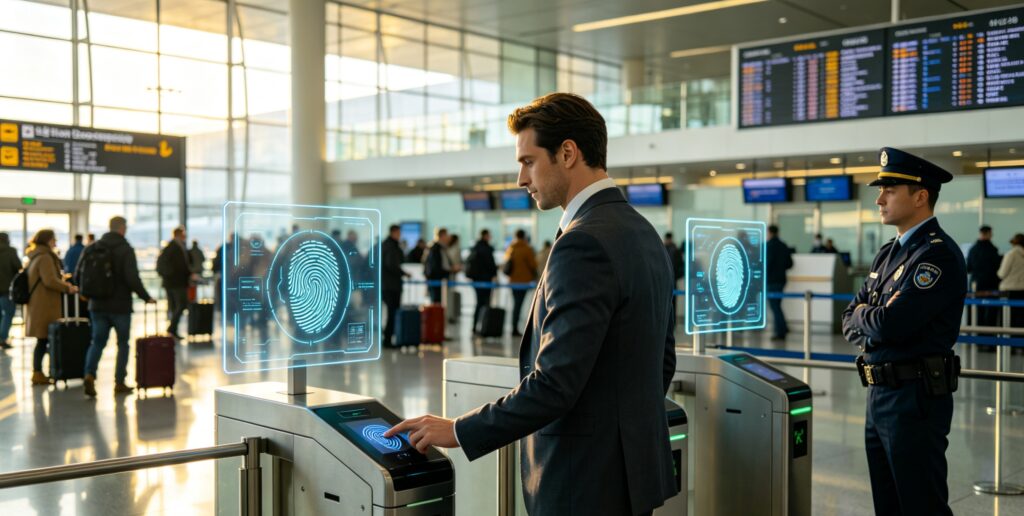
Every international journey begins with a simple goal: reaching your destination without unnecessary delays or complications. Yet, during the visa application process, travelers quickly discover that not every country follows the same rules. Some embassies require applicants to visit a visa application center to provide fingerprints and a digital photograph, while others allow applications to be completed entirely online or by mail without collecting any biometric information. This difference often leaves travelers wondering why the requirements vary so much.
Understanding the purpose of biometrics and why different countries have adopted different policies can help you prepare for your next trip with confidence and avoid unexpected surprises during your visa application.
What Are Biometrics, Exactly?
Biometrics refer to unique physical or behavioral characteristics used to verify a person’s identity. In the context of international travel, this typically includes fingerprints, facial recognition scans, iris scans, and occasionally palm prints. Unlike a passport number or a name, which can be forged or duplicated, biometric data is tied directly to the individual’s body, making it far more difficult to fake. This is precisely why more governments are adopting it as part of their border control systems.
The Security Argument
The most common reason countries cite for requiring biometrics is national security. Governments want to be certain that the person crossing their border is exactly who their documents claim them to be. Biometric systems help prevent identity fraud, document forgery, and the use of stolen passports. They also allow authorities to cross-check travelers against watchlists and criminal databases far more accurately than a manual document check ever could.
Countries that have experienced significant security threats, terrorism concerns, or high volumes of undocumented migration often invest heavily in biometric infrastructure as a preventive measure. The United States, for example, expanded its biometric collection significantly after the September 11 attacks, introducing fingerprint and photograph requirements for most foreign visitors. The logic is straightforward: a face or fingerprint cannot be easily swapped or stolen the way a paper document can.
Technology, Infrastructure, and Cost
Not every country has the financial resources or infrastructure to implement biometric border control. Setting up biometric systems requires substantial investment: specialized scanning equipment, secure databases, trained personnel, and ongoing maintenance. Wealthier nations and major travel hubs are typically the first to adopt these systems because they can absorb the cost and because their airports handle enough traffic to justify the expense.
Smaller nations, or those with limited tourism infrastructure, may rely instead on traditional passport checks, visas, and manual verification. This isn’t necessarily a sign of weaker security; it often simply reflects budget constraints or a lower volume of international arrivals that doesn’t yet justify the investment.
Regional and Political Cooperation
Biometric requirements are also shaped by regional agreements and political alliances. The European Union, for instance, has been rolling out systems requiring biometric data collection for many non-EU visitors across the Schengen Area. This is a coordinated regional effort, meaning that once fully implemented, travelers will encounter similar biometric procedures whether they land in France, Italy, or Germany.
On the other hand, countries that are not part of such regional systems may set their own independent rules, leading to inconsistency. A traveler might pass through five countries in a single trip and encounter five different levels of biometric scrutiny, simply because those nations have no unified agreement on the matter.
Data Privacy Concerns and Public Trust
Not all governments are equally comfortable with mass biometric collection, and not all populations are equally trusting of it either. Countries with strong data privacy laws or a history of public skepticism toward government surveillance may be more cautious about implementing biometric systems, or may implement them with strict limitations on how long data can be stored and who can access it.
This is an important consideration for travelers as well. Biometric data, once collected, is often stored for years and shared between government agencies or even allied nations. Understanding a country’s data retention policy can help travelers make informed decisions about the information they share, even if declining isn’t usually an option at the border.
Tourism Strategy and Traveler Experience
Interestingly, some countries view biometrics as a way to improve, rather than hinder, the traveler experience. Automated biometric gates can actually speed up immigration processing, reducing long queues at busy airports. The United Arab Emirates and Singapore, for example, have invested in biometric e-gates specifically to make entry faster and more convenient for the high volume of tourists and business travelers they receive each year.
In these cases, biometrics are not just a security tool but a strategic feature designed to enhance a country’s reputation as an efficient, modern, and welcoming destination. Countries competing for tourism revenue often weigh the trade-off between rigorous security and a smooth, pleasant arrival experience.
What This Means for You as a Traveler
For everyday travelers, the inconsistency in biometric requirements simply means one thing: preparation matters. Before any international trip, it’s worth checking the specific entry requirements of your destination country, including whether biometric data collection is required upon arrival, departure, or both. Some countries require this only once, while others recollect data on every entry.
Travelers should also be aware that refusing to provide biometric data, where required, will typically result in denied entry. It is rarely optional once a country has made it a formal requirement.
Conclusion
The decision to require biometrics ultimately comes down to a blend of security priorities, financial capability, regional cooperation, public trust, and tourism strategy. There is no single global standard, and this patchwork of policies is likely to persist for years to come as different nations weigh the costs and benefits differently. For travelers, the best approach is simple: stay informed, check requirements well in advance, and treat biometric checkpoints as a normal, evolving part of modern international travel rather than a cause for alarm.
Safe travels, and always double-check your destination’s entry requirements before you pack your bags.
Fill this FORM to get visa support today.

Other Articles

How to Choose the Right Airline for Long-Haul Travel




No Comment! Be the first one.