


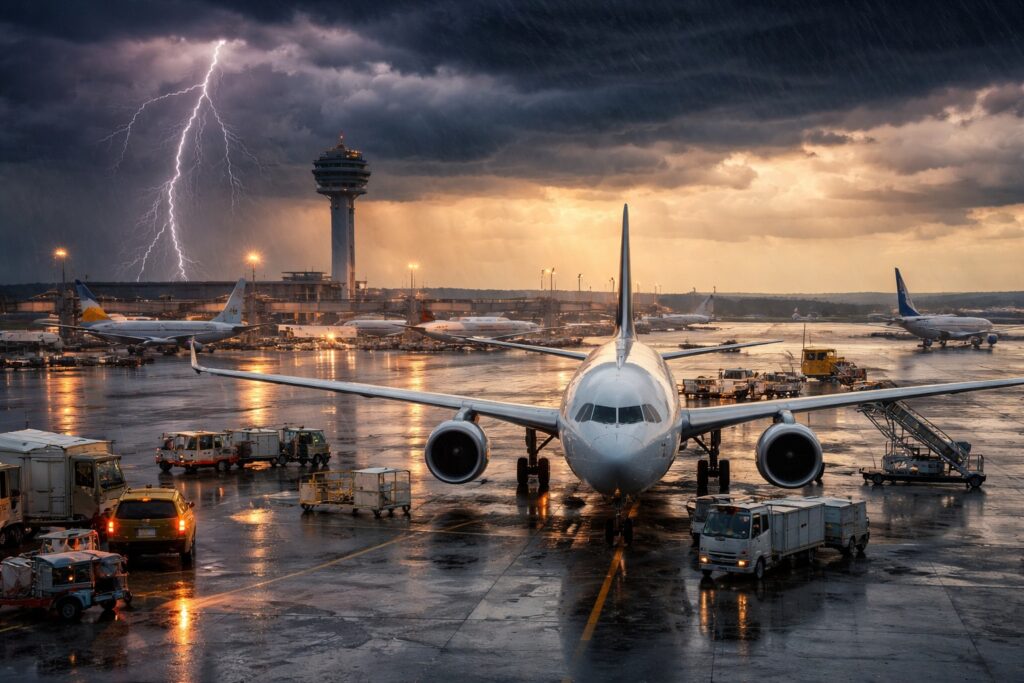
Air travel is often presented as a smooth, well coordinated system powered by technology, precision, and experience. Airlines advertise punctuality. Airports highlight efficiency. Yet, every year, millions of passengers face unexpected delays that disrupt business meetings, holidays, family events, and even medical appointments. While airlines sometimes point to operational challenges, crew availability, or air traffic congestion, one major factor quietly sits behind many of these disruptions, weather. Weather affects flight delays more deeply and more frequently than most travelers realize.
Understanding how it works gives passengers clarity, realistic expectations, and better preparation for their journeys.
Weather Is Not Just About Rain and Storms
When passengers think of weather delays, they usually imagine heavy thunderstorms or blizzards. In reality, weather related disruptions are far more complex. Aviation depends on visibility, wind direction, air pressure, temperature, and runway conditions. Even mild changes in these elements can slow down operations.
For example, low cloud cover reduces visibility, which forces pilots to rely more heavily on instrument landing systems. When visibility drops below certain safety thresholds, fewer aircraft can land or depart within a given period. This immediately creates a backlog. It may not look dramatic from the terminal window, yet the impact is real and measurable.
Similarly, strong crosswinds can limit which runways are safe to use. If an airport normally operates four runways but weather conditions restrict it to two, capacity drops sharply. Fewer takeoffs and landings mean delays begin to accumulate.
Thunderstorms and Air Traffic Bottlenecks
Thunderstorms are among the most disruptive weather events in aviation. They bring lightning, heavy rain, turbulence, hail, and unpredictable wind shifts. Pilots are trained to avoid flying directly through these systems, and air traffic controllers reroute aircraft to maintain safety.
This rerouting causes congestion in the sky. Aircraft that would normally follow direct paths are forced into longer routes. Holding patterns form near busy airports. Each additional minute in the air affects scheduling for other incoming and outgoing flights.
The delay does not stay local. If a storm affects one major airport, aircraft scheduled to depart later in the day from another city may also be delayed because the incoming plane has not yet arrived. This is known as a ripple effect. A single storm system can disrupt an airline’s network across multiple countries.
Snow, Ice, and the Hidden Time Factor
In colder climates, snow and ice create a different type of challenge. Aircraft must be completely free of ice before takeoff. Even a thin layer can affect lift and performance. Deicing procedures are thorough and necessary, but they take time.
During peak winter periods, long queues form for deicing. Airports may also need to clear runways repeatedly if snowfall continues. Each cleaning cycle temporarily pauses departures and arrivals.
Passengers often see the snow and understand the delay. What they may not realize is that even after snowfall stops, operations do not instantly return to normal. Aircraft and crews may already be out of position. Recovery can take hours or even days.
Heat and High Temperatures
Extreme heat is an underestimated cause of flight delays. High temperatures reduce air density. When air is less dense, aircraft need more runway distance to generate enough lift for takeoff. In very hot conditions, especially at high altitude airports, planes may face weight restrictions.
This means airlines may need to offload cargo, limit fuel, or even delay departures until temperatures cool slightly. While this may not sound dramatic, it affects scheduling and turnaround times.
Heat can also strain airport infrastructure. Runways can soften. Equipment can overheat. Ground crew productivity may slow due to safety precautions. All of this contributes to operational delays.
Fog and Low Visibility
Fog is one of the most frustrating weather events for passengers because it can appear suddenly and linger unpredictably. Even airports equipped with advanced landing systems have minimum visibility requirements.
When visibility falls below those limits, flights cannot land. Aircraft are either diverted to alternate airports or held in the air. Diversions create additional challenges, including refueling, passenger rebooking, and crew time limitations.
Airlines rarely control fog conditions. However, they must manage the consequences, which often result in schedule adjustments that stretch into the following day.
Hurricanes and Large Scale Disruptions
Tropical storms and hurricanes cause large scale cancellations and delays, sometimes days before landfall. Airlines often cancel flights proactively to reposition aircraft and avoid aircraft being stranded in affected areas.
This may appear cautious, but it is rooted in safety and operational planning. Once a major storm hits, airports may close entirely. Recovery involves inspecting runways, terminals, navigation systems, and surrounding infrastructure.
The disruption is not limited to the storm location. Aircraft assigned to those routes may have been scheduled for multiple flights afterward. When one link breaks, the entire chain feels the impact.
Why Airlines Do Not Always Emphasize Weather
Airlines operate in a competitive industry. On time performance is a key selling point. Publicly attributing delays to weather can be accurate, but it does not always satisfy passengers who experience missed connections and disrupted plans.
In some cases, weather may not be the sole cause. A minor weather event combined with tight scheduling, limited spare aircraft, or crew availability can create a larger delay. Airlines may categorize delays differently depending on internal reporting systems.
Passengers often feel that airlines are avoiding responsibility. The truth is more nuanced. Aviation operates as a complex system. Weather interacts with operational planning, airport capacity, and regulatory constraints.
Airlines are also required to follow safety regulations set by aviation authorities. Pilots and dispatch teams cannot simply push through adverse weather conditions to maintain punctuality. Safety margins are non-negotiable.
The Global Network Effect
Modern aviation is interconnected. A delay in one region can cascade across continents. Aircraft are scheduled with minimal downtime to maximize efficiency. While this improves affordability for travelers, it leaves a limited buffer when disruptions occur.
If heavy rain delays departures in one city, that aircraft may arrive late to its next destination. The crew assigned to operate the return flight may exceed legal working hours if the delay is too long. In such cases, the airline must assign a new crew or cancel the flight.
This chain reaction illustrates how weather in one location can affect passengers who are nowhere near the original storm or snow event.
Technology and Weather Forecasting
Aviation relies heavily on meteorology. Airlines have dedicated weather teams. Pilots receive detailed briefings before every flight. Airports use sophisticated monitoring systems.
Despite advanced forecasting tools, weather remains unpredictable. Thunderstorms can intensify quickly. Wind patterns can shift. Forecast models provide probabilities, not guarantees.
Improved technology has reduced weather related accidents significantly over the decades. However, safety improvements often mean stricter operational limits. What may have been considered acceptable decades ago is now restricted under modern standards.
What Passengers Can Do
While travelers cannot control weather, they can prepare strategically. Booking early morning flights reduces the risk of cascading delays because aircraft are more likely to be in position at the start of the day.
Choosing direct flights minimizes connection risks. Monitoring weather forecasts for both departure and arrival cities helps manage expectations. Travel insurance can provide financial protection for extended disruptions.
Passengers should also understand airline policies regarding weather related delays. Compensation rules often differ when delays are caused by extraordinary circumstances such as severe weather.
Patience is not always easy, especially during important trips. However, understanding the role of weather provides perspective.
The Bigger Picture
Weather is not an excuse. It is a fundamental factor in aviation safety and performance. Airlines may not always highlight the depth of its impact, but the evidence is clear. Visibility, wind, temperature, storms, and seasonal patterns shape daily operations worldwide.
Flight delays are frustrating. No one enjoys sitting at a gate watching departure times change. Yet behind every delay announcement is a system designed to prioritize safety above speed.
Aviation is one of the safest modes of transport in the world because it respects weather limits rather than challenges them recklessly. When a flight is delayed due to weather, it often reflects caution rather than inefficiency.
Understanding this reality allows travelers to make informed decisions, plan wisely, and approach disruptions with a balanced mindset. Weather may not always be visible from the terminal window, but its influence stretches across every runway, flight path, and timetable.
In the end, airlines and passengers share the same goal, to arrive safely. If that sometimes requires waiting out a storm, clearing a runway, or adjusting a schedule, it is a price worth paying for safety in the skies.
Fill this FORM to book your flight today.
FORM

Other Articles

What Schools Don’t Tell You About Course Workload
Why Some Tickets Can’t Be Upgraded No Matter the Price


No Comment! Be the first one.